Posts

Olivier Messiaen plays Olivier Messiaen part 3

Image
This is the third and penultimate release with Olivier Messiaen playing his own works for now. The last works missing is his “Messe de la Pentecôte” and his “Livre d’Orgue”. Oliver Messiaen also recorded the “Méditations sur le mystère de la Sainte Trinité”, but since it was composed in 1969 it was from obvious reasons not included in the 1956 recording sessions. He recorded the “Méditations” in 1972, but we’ll have to wait until 2022 for a public domain release of that. I’ve already covered many sides of the circumstances connected with these recordings, so I’ll again let Timothy Tikker speak. This time it's concerning the interpretations by Olivier Messiaen, and also draw attention to his excellent article from The American Organist (Nov 2008): “Identifying Messiaen as a romantic performer may seem surprising, when so many think of him as the ultra-modernist who, for example, did so much to introduce total serialism in composition. And yet, he admitted plainly: "I'm not...

Olivier Messiaen plays Olivier Messiaen part 2

Image
The second part of the complete Olivier Messiaen plays Olivier Messiaen consists of Apparition de l’Èglise éternelle and Les Corps Glorieux. I discussed the technical and historical details in the first release, so I’ll not go into these details again. As mentioned in the first release, I’m very reluctant in naming the definitive renditions of any works, but Messiaens own interpretation of the Apparition is simply amazing. His tempo is extremely slow but never dragging and his overall musical perception of the piece is so incredible grand. In fact looking over just a few other recordings of this piece puts Messiaens version as the slowest: Olivier Messiaen (1956) 10:05, Latry (rec. 2000) 9:45, Rudolf Innig (1996) 9:16, Jennifer Bate (1982) 10:00, Susan Landale (1986) 7:36, Thomas Trotter (1993) 9:48, Louis Thiry (1972) 8:01. The overall timing of a piece doesn’t directly tell anything about the actual tempo (or tempi) in a piece. There are many other factors in play, just listen to the...

Olivier Messiaen plays Olivier Messiaen part 1

Image
Olivier Messiaen (1908-1992) Olivier Messiaen hardly needs any introduction at all. He was one of the most influential composers of the 20th century and organist at Trinité in Paris for 61 years! Here is a little excerpt from Wikipedia anyway: “Olivier Messiaen; December 10, 1908 – April 27, 1992) was a French composer, organist and ornithologist, widely regarded as one of the major composers of the 20th century. His music is rhythmically complex (he was interested in rhythms from ancient Greek and from Hindu sources); harmonically and melodically it is based on modes of limited transposition, which he abstracted from his early compositions and improvisations. Many of his compositions depict what he termed "the marvellous aspects of the faith", and drew on his deeply held Roman Catholicism. He said he perceived colours when he heard certain musical chords, particularly those built from his modes (a phenomenon known as synaesthesia); combinations of these colours, he said, wer...

The Complete Charles Tournemire - remastered by Charles Lever

Image
I’ve been rereleasing some recordings before, but I’ve never rereleased a whole set of recordings before. The reason why I’m rereleasing the Complete Charles Tournemire is because the present transfer is simply the best restoration of I’ve ever heard. The original 78s are from the collection of Michael Gartz, who has been a great supporter of this site and is remastered by Charles Lever. When you remaster old recordings, you are always faced with problems concerning how much noise you are going to remove and how much equalization you are going to make. When you remove noise, you always remove a little bit of the music as well. So when you restore old recording, you are in fact interpretating the music as well; you can alter the actual the timbre of the instrument and you can “color” nuances as it fits you – in other words it is basically up to the aesthetics of the audio technician how the music is going to sound! I’ve heard many(!) transfers of old recordings, some are completely free...

Jeanne Demessieux, Günther Ramin and Páll Isólfsson (recordings from the 1950s)

Image
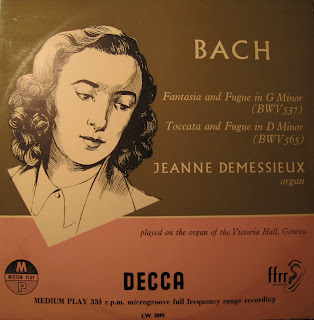
This release consists of three sets of recordings. First we have yet another release with the ever inspiring Jeanne Demessieux playing the infamous J. S. Bach Toccata and fugue in d and the J.S. Bach Fantasie and fugue in g-minor from Victoria Hall in Geneva. She recorded several times at Victoria Hall in Geneva. These two pieces were recorded in September 1953 and released on Decca in 1954 on a 10 inch LP. Her version of the Toccata and fugue in d-minor is simply the most electrifying version, I’ve ever heard, and I’ve heard many recording of this piece – it rivals Alfred Sittards great rendition of it from 1928 in Hamburg. The next two items are Günther Ramin playing Max Reger, a Deutsche Grammphon 10 inch LP from 1958. The cover states, “Thomaskantor Günther Ramin an der Beckerath-Orgel”, but it doesn’t state where, and I simply can’t find out. I’ve searched the internet, so please help me here… I found a not-so-fond-of review from The Grammophone, July 1958, which among other thin...

Marcel Dupré in Queens Hall - 1926-27

Image
Now it’s time for another Marcel Dupré release. This time is probably some his earliest recordings made in Queens Hall, London in 1926 and 1927. Marcel Dupré marked in many ways the “modern” way of playing, and he was immensely popular everywhere he played and most definitely also in England. HMV was, as far as I know, the first European record company who seriously made organ recordings. I think it was due to the fact, that many of the organists in England were very popular to the people in general. The many concert hall organs popularized the organ and organ music, and many organists could fill concert halls with an enthusiastic audience. So in England were a broad marked for selling organ recordings. A lot of these recordings are, taken the age in consideration, of very high quality and the sound is remarkably clear. One easily forgets that the recordings are over 80 years old. These recordings are important of several reasons. First of all they document the organ at the old Queens...

Various organists playing organ works by Johann Sebastian Bach

Image
This is the 20th release and to celebrate this I’ve chosen different works by J. S. Bach played by five different organists. As you can see, there are two duplicates; the Alfred Sittard and Fernando Germani have already been released (IHORC-02 and IHORC-11) but the transfer was made from other 78rpms which are of a quality worth presenting here. Looking back over the 20 releases here on IHORC, it’s very clear that recording organ works J. S. Bach for an organist of that period was standard, and the repertoire is quite broad. Of course there are numerous versions of the famous Toccata and Fugue in d minor, but about all genres of his organ works are represented here in some form or another. All the organists tried their hands on the “big ones”, but they also ventured into the more elusive parts of his organ production, e.g. Heitmann recorded the “Kunst der Fuge”, Walcha the “Schübler Chorales” (on the other hand Walcha has recorded the complete works twice, so he is a little out of the...